
The 4-Hour Chart
No, this is not a Timothy Ferriss promotion or new book, but an examination of the 4hr chart, along with the how and why I recommend using it for your price action trading.
If you are in the beginning or developmental stages for learning how to trade the forex market, I definitely recommend learning to read price action off the 1hr, 4hr an daily time frames. For our purposes, we will concentrate on the 4hr chart.
Some Advantages of the 4hr Time Frame?
Price Action is the result of order flow (the total summation of all buy and sell orders). It really matters not why people buy and sell, or if they are buying and selling, what matters is who has dominant control of the market, where is the market most likely to go, and how can we trade it.
With that being said, a few minutes of price action can more often than not, represent a false move, perhaps Toyota buying some USD with JPY, and very likely have any significant force behind it to drive the market, bring in other players, and be the start of a big move.
Think about it…how many 1min, 3min, 5min, 10min, 15min, or even 30mins of price action throughout the day will really be representative of a major move and driving force throughout the day?
Now, think about the 4hr chart. No matter how you slice it, 4hrs is half of a trading session (for the most part). For any trading session, a 4hr candle will represent a large sum of order flow, sentiment, continued or sustained buying/selling, etc. If a rejection happens on a 4hr chart, it likely represents a large rejection because to sustain that rejection, the market had to close the entire 4hr candle while maintaining the rejection till the end. If it rejects during the 4hr candle, but closes exactly where it rejected, then it wasn’t that important because it couldn’t sustain that rejection in time.

Time is a critical component when reading price action and representing order flow. In many cases, the longer price reacts/rejects off a key level, the longer it holds from that rejection, the stronger it can be. Of course the price action context leading up to it is key and informative, so make sure to understand this.
But if a key level can sustain the directional move for 4hrs as opposed to 5mins, then it had to do so through increased order flow and participation from the market. That communicates there were more players and more money behind this move.
But on a 5min candle, or even a 1min candle, this could be nothing and represent little/meaningless order flow with no real potency behind it. It could be the result of some minor profit taking which creates a negative feedback loop in terms of order flow and price action. But do this for 4hrs and sustain it into the close, and we are talking more participation, orders, money and participants.
For price to sustain a particular price action move for 4hrs means no matter how many players, sentiments, and ideas there were participating in the market, the dominant theme held for half the trading session and quite a long time. But on a one min time frame, a 5min, or even 30min time frame, these moves could be simple noise which can move the market up to 30pips without having any major force behind it. Think about how many 5min candles in between the NY close and Tokyo open and how much order flow will really be behind that? Think about how many 1min and 3min candles will be between the 3rd and 4th hours of the london session (where volatility and pip ranges generally decrease) and how they will represent less order flow and participation. Then you will see how ineffective these candles can be and how what your reading has very little meaning.
One and Two Bar Patterns
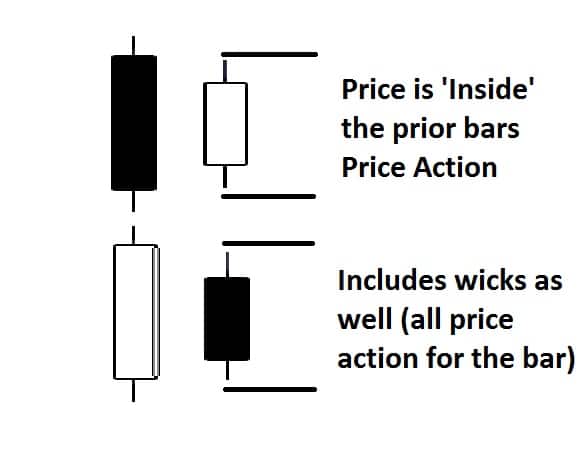
Continuing with that logic, for those who trade pure price action patterns, like an inside bar (which is a 2 bar pattern) shows up on a 1min, 3min, 5min or even 30min time frame, it is much more likely to be absolutely meaningless than an inside bar which shows up on a 4hr time frame.
Think about it, if price holds inside the previous price range on a 5min candle, that could mean almost anything and be the result of a laundry list of order flow environments and situations. 5mins of price going nowhere could mean anything and have very little direction on upcoming order flow.
But apply an inside bar on a 4hr time frame, and you are talking 4hrs of price action being held in a range for almost half an entire trading session. That means no matter how many players participated in the market, nobody was able to break the previous price range for an entire 4hrs which tells you a) price was pretty suppressed, b) very little directional control in the market, c) very little participation. That is much more communicative in terms of information than any passing 5mins.
The market could be in a dominant trend, but be simply pausing for 5mins because its coming to lunchtime, there were some short term counter-orders/forces in the market that will be quickly absorbed, a little profit taking (again, a negative feedback loop on price action and thus, not great for trading). Technically, for an inside bar pattern, you would be basing your decision on 8hrs of price action since an inside bar pattern is a 2bar pattern (thus 8hrs), so there is a lot more information in this then an inside bar pattern on a 5min time frame (10mins of price action).
Furthermore, to get any real significant amount of data with confirmation and continuation of the order flow (and price action), you need far more 1min, 3min, and 5min candles to make sure the noise is filtered out. That means more moving parts and more variables to manage. Contrast to the 4hr chart where one candle (or two) can give you all the information you need to make a trade while filtering out any noise and meaningless price fluctuations.
For an interesting story about meaningless price fluctuations, make sure to put in a question in the comment box below and i’ll tell you a story which will blow your mind.
In Conclusion
As we can see, when trading and reading price action, a 4hr candle will offer us much more information, and have a cleaner look and feel to it than any 1min, 3min or 5min chart. This will make it easier for you in your learning process as you’ll be making decisions off of less false signals, more information and cleaner charts.
The 1hr, 4hr and daily time frames will have a greater communicative value about direction, clear support/resistance levels, what is a key rejection, who’s in control, while filtering out noise and meaningless order flow and price action. This will give you less confusing information in the beginning, and teach you how to be patient with your trading.
Once you have developed your skills, have some experience and confidence under your belt, it’s really up to you from there how you want to trade, whether it be on the smaller time frames (1min – 30mins) or larger time frames (1hr, 4hr and daily). At that point, it’s a question of style and life-style.
But it should be noted we aren’t saying trading on the lower time frames is meaningless. One can trade price action on any time frame and make money. In fact people are making money on almost every time frame available.
Just understand you have to increase your price action skills and ability to read price action context before trading lower time frames. For some people’s brains, it doesn’t work with their natural wiring and dispositions. For other traders it does, so the key is finding what works for you. If it hurts your brain, then it likely isn’t for you, so make sure whichever style you trade isn’t hurting your brain, but engaging it well.

For those of you wanting to learn how to read price action and the order flow behind it, take a look at our Advanced Price Action Trading Course where you will learn rule-based price action systems to trade the forex market.
Please remember to leave your comments below and to ‘Like’ and ‘Tweet’ to share the article.
Also make sure to check out our most recent article on Price Action Trading.

Hi Chris. I hope you remember me. Happy New Year! I may be late for commenting this article so my apologies. The above article really (really) explains so clear that I can see through the crystal ball (ha ha). I had completely forgotten about “order flow” as this is the key in understanding how the market works when viewing lower TF compared with 4 hr TF. I notice you mentioned to insert a question here. Funny I do have a question in mind. When trading on 1HR TF, do you make sure the trend is in the same direction as 4HR TF? (I am sure this will blow my mind). I have printed and placed it in my trading book fore reference. Thanks a million !
Robert
I like trading the 4 hour charts with the 1 hour charts. Am glad you shared this article about trading the 4 hour time frames as I combine this with my price action analysis.
Man you are a true market wizard. I have been following your methods and they are what I’ll always follow as my live acct continues to grow. Keep up the great work.
I am definitely taking notes here about trading the 4hr charts doing set and forget trading. I work all day, so was looking for a way to trade.
thank you a million and looking forward to more content from you
i have doubt in harmi bar ,how it possible a candle stick open & close within the body of previous bar (when previous bar close during that time next bar opens )in that point of view HARMI,BULLISH,BEARISH ENGULF PATTERN FAILS.can explain this also.
CAN YOU ABLE TO GIVE LAST 10 YEARS 4HR candle stick in UK OPENING TIME FRAME AND US CLOSING TIME FRAME 4 HOUR CHARTS. if possible please tell the dot com OTHERWISE if you have such practice of print screen chart when you did in past,can you mail me, for better understand for my future prediction.
Hello Asr,
Perhaps you did not read my last response, so please read that first.
But this information you are asking for is for paid course members which you are welcome to join.
Kind Regards,
Chris Capre
i’am practicing fx in 4hr time frame ,i’am using us closing,uk opening.time if long upper shadow bar comes means ,next movement goes to up or down,i want to know ,then if long lower shadow bar comes means ,next movement goes to up or down, (SOME TIME I CAN’T UNDERSTAND upper & lower shadow OR hanging man & shooting board .etc.))can you explain this detaily with example .(eur/usd pair) .one day uk time signal is working well but another day us closeing time working well.
Hello Asr,
We do not approach price action in such a mechanical manner making trading decisions based on pure patterns only. We first understand price action context as there is no one answer to your question, and no clear answer without context.
For an article about price action context, visit the link below.
https://gammalevelcorp.wpengine.com/strategies-for-forex-trading/forex-articles/setups-price-action-and-context/
Kind Regards,
Chris Capre
Hello Chris,
Thank you for your compelling article covering the 4hr charts. It is the best educational posting I have come across! Furthermore, it has cemented my decision to trade the XAU/USD during this time-frame.
hello chris
thank you for your valuable explanations
but i have seen a lot in your emails and also in your website that you said
thinking about trading price action just in higher time frames is not true
and if someone tells us about we must trade price action just in higher
time frames , he or she absolutely mislead us.
can you explain why you have such a big Inconsistency in this special subject?
thank you
Hello Seyed,
Hmm, I think there is a misunderstanding here. There are certain people who say the ONLY way, or the BEST way to make profitable trades using price action is on the higher time frames.
This is not always the case, and so I disagree that the ONLY way, or the BEST way to be profitable is on the higher time frames. There are many time frames one can trade profitably if one learns the skills.
So there is no inconsistency here.
Kind Regards,
Chris
Hello, Mr. Capre.
Thank you very much for the comment in your very busy schedule.
After having read your comment, I feel now that I have missed the truly important thing and have cared too much about the thing which is secondary for a long time.
The cause for that probably been, my mind has been geared toward “how” aspect of the trading much without me having realized it.
Best regards.
Kenichi Kamada
Hello, Mr. Capre.
Thank you always for your great insight.
I have really enjoyed your article, and, at the same time, I think that I have gained very meaningful suggestion from your article for me to deeply rethink my perspective about trading timeframe.
By the way, I want to ask one question which has bothered my mind for a long time.
That one question relates to the fact that the form of 4HR candles varies so much between different charting software.
For example, I am currently using three charting software which are Intellichart, MT4 of Alpari Japan with live account and MT4 of FXDD with demo account.
And, I must add that both of Alpari Japan MT4 and FXDD MT4 use NY session closing time data.
Then, when I compare the 4HR candles of those charting software, the 4HR candles of two MT4s are almost identical. But, the 4HR candles are the completely different things between two MT4s and Intellichart.
Actually, there had been a brief period when I had subscribed to Esignal and Pro Real Time.
But, just after subscribing, I instantly ceased to use those charting software. The reason for that is the complete difference of 4HR candle forms between Esignal, Pro Real Time, MT4s and Intellichart.
Especially as for the reason of subscribing to Esignal, I had sought the charting software whose price data is the absolute reliable one. But, the difference of the 4HR candle forms I had noticed just after subscribing had really discouraged me.
And, I also noticed the slight difference of the daily candle forms. So, I had become at the loss of what to believe.
I have observed many times that the 4HR timeframe often creates really beautiful trending chart. And, thanks to the great article of yours about higher timeframe trading, I really want to concentrate on the timeframe more than 1HR, especially the 4HR timeframe as my main trading timeframe from now on.
But, just now, I cant put full confidence on the 4HR chart to use for the trading decision due to the different forms of 4HR candles which I have described so far.
I know that you have used Intellichart. That fact made me very happy when I knew about that for the first time.
And, when I searched web for the best charting package, Intellichart was highly regarded.
But, the complete difference of 4HR timeframe candle forms has not left my mind.
Would you give me any suggestion about how to deal with the problem I have described?
Best regards.
Kenichi Kamada
[email protected]
Hello Kenichi,
A massive question but a good one. First off, its important to realize there is no ‘fixed’ time frames for the 4hr charts that everyone is using, or is the ‘correct’ time frame setup while others are not. My fxtrek slices the 4hr charts differently by starting 1hr into the london open. Others start at the london open. Both can work which is why I cover this in the course.
The key is to find one that works for you and just trade those. This is why we provide a quantitative edge in the course sharing the differences in 4hr start times.
So no reason to be discouraged, just know the differences and trade accordingly.
Kind Regards,
Chris Capre
Hi, I just read you recommend NY close for 4 hour candles, did you all ever study 4 hour candle formations on GMT based time charts?
Hello Rick,
I actually recommend several types of 4hr candles, NY close is one of them. GMT 00.00 also works as well but it depends upon the specific system being used as some work well with one system, but not another.
Kind Regards,
Chris Capre
Please tell me the story about meaningless price fluctuations…..
Hello Chris,
I am already subscribed to paid price action advisory services.
They are mainly training courses and information seems to be same like trading 4 hr and daily charts and go to 1 hr rarely. They also talk about New York close charts and two or three entry methods based on pinbars and inside bars.
Will it be additionally beneficial to join your course?
What is different?
Thanks
Girish
Hello Girish,
I have a feeling I know which services you are referring to.
My thoughts are if patterns like inside bars and pin bars on 4hr and daily charts were enough, then why would banks be spending thousands of hours training their traders when it could be so simple?
The answer comes down to context and reading price action in context – not just a few simple patterns
This is what I teach in my course, how to go beyond some simple patterns to read price action in real time, and trade it.
In this course I teach you how to trade trends, pullbacks in trends, transitions in trends, find key reversals, high probability breakouts, critical support and resistance levels, along with proper risk management and successful trading psychology so quite a lot.
Hopefully this gives you some good information to work with.
Thoughts?
Kind Regards,
Chris Capre
Thank you for your sincere reply.
I think have invested more in all training and guidance systems than my trading account and it has caused more confusion. Hence I have come down to my old proven and tested method of of 5 and 13 ema crossover in direction of 55 ema. I am getting good results and looking to apply it on Indices on daily time frames.
I read with interest your dailt mails but they seem delayed by a day.
Hello Girish,
None of my daily mails and posts are delayed – I’m just in the US time zone which may explain it.
All the best and good luck trading.
Kind Regards,
Chris Capre
Please share the story…
Hi Chris,
I like your way of approaching to trading and also to the traders.
The Example which u compared the psychology of trading is absolutely true and amazing also.
Great article Chris.
Very Good
Hi Chris, I can’t wait to hear your story. Must be pretty interesting.
Hello Chris,
I find that using large time frames requires large protective stops. How does a person, who may be more consertive in their trade management, find balance between using large stops in a coservative approach?
To be more clear, how do you use large time frames, large risk and balance thise with a more conservative trading approach?
That’s an easy one as there’s only one way – position sizing. Large timeframes don’t have to equal large risk, except in pips – but not in dollar amount or percentage risked. Reduce your size until you’re risking the same amount as you would on a smaller timeframe with your usual risk parameters.
Hello Mike,
Gabriel (who is one of my top students), hit the nail on the head. Stop size has nothing to do with risk by itself. Position sizing + stop size does. I can have a 1000 pip stop have less risk than a 30. How? Via position sizing.
So using larger time frames while managing risk and being ‘conservative’ are easy to do.
Kind Regards,
Chris Capre
i have been looking throughout the internet, but the above article is the most thorough. i have been looking at the 5min chart and the 2minute chart the past 2 weeks but thoroughly burnt out. i think even a 15minute chart is quite a lot of data. it is too short time to make decisions. so i will consider higher timeframe like 1hr looks good. you can always reduce position size re stop for a beginner, and you can monitor a bit more pairs if you want more signals.
Chris,
This is the finest explanation I have read about 4 Hour Candle.
Thanks a lot for sharing.
FP
Hello FP,
Glad you liked it and found it valuable.
Kind Regards
Chris
Thank you Chris. Since I moved from 15m and lower to 4h and daily charts my trading has improved and I’m a much calmer and more relaxed trader because I know the result will take time as I’m not chasing 10 pip trades anymore. It allows me to close the charts and not look at them for several hours. Very glad you wrote about this. Your course/s are amazing and highly recommended to anyone who likes the higher time frames.
Hello Desiree,
I am glad to hear the move up in time frames has not only improved your trading, but also helped you trade more relaxed and calm which is critical to trading.
And yes, its important to feel like you can trade from the charts while being able to walk away – gives you a sense of freedom and control to do other things and not
be married to the charts like Johnny Bench.
Thanks for the kind words on the courses. Always good to work with you.
Kind Regards
Chris
Hey Chris, can u plz tell me your story about meaningless price
fluctuations that will blow my mind ? thnks Senzei
Mike Fetters
Hello Mike,
I already did so in the webinar that came after I wrote this post so go ahead and check out my webinars
around that day and you will hear the story.
Kind Regards,
Chris
not a huge fan of higher TFs. e.g. last few weeks on higher TF it looks like a snooze
To the trained eye there has actually been plenty of signals on the 4hr charts and the daily as well. We recommend a range between the 1hr, 4hr and daily charts which should give the trader plenty of action across several pairs. Remember though, trading is not for one’s entertainment, it’s for making money consistently over time and there are certainly ways to do this via the 1hr, 4hr and daily time frames.
Kind Regards
Chris
When you speak of New York close, and London open, are you recommending calibrating pivots according to either one of those times? In the case of “New York close,” your first choice, would this really mean New York open all the way to New York close would comprise the week, and London activity prior to the New York open would be ignored? Is it OK to ignore Sunday activity? Sorry I can’t wrap my head around this quickly tonight. Will watch/listen to the webinar in recorded form.
Hello Nandrani,
I recommend calibrating pivots to the London open if you can, if not, then the NY close. This does not mean the NY open to NY close, it means the 24hr period from NY close to NY close or 5pm EST to 5pm EST
I ignore sundays for sure
hope this helps
CC
Hi Chris,
thanks for all the information. Wish I knew about the beauty of the higher time frames when I first started in forex. My trading only took off after I moved up from lower time frames to 4h and daily, and I remember I got the advice from one of your webinars. Looking forward to your stroy at this Tuesday’s webinar.
Best Regards,
pliu
Hi Chris,
Thanks for answering the favorite time frame question.
All this informations and helps for free!,you are such a gem.
I absolutely agree with you. Lower time frames are a quick and easy way to empty your account. So much adrenaline and gut spilling and dramatically increases the learning curve exponentially.
Thanks as always,
Chima
Hello Chima,
Am glad you are enjoying these articles.
The lower time frames can be learned but the learning curve is much longer, more steep and also usually a roller coaster ride (which the trading process already is)
which is why I endorse these 4hr time frames for the learning process. After that, its a question of style.
See you at the webinar
Kind Regards
Chris
I agree with what you have to say. besides, the major swings are easily spotted in 4h charts because it resembles the daily chart to a certain degree as well. i really believe that the 4h charts is our view between the forest and its trees. hmmm its canopy.
ps Id like to hear that story
Hello Earvin,
Yes, good insight and intuition – that the 4hr charts is a nice balance between the shorter term and longer term views – couldn’t agree more.
Come to the webinar to hear the story so see you there.
Kind Regards
Chris
Chris, if on your recent journey a Uruguayan border official had informed you that in Uruguay the law states you can trade one timeframe and only one and that you must declare that in advance of entry,what would your answer be?!!
Michael.
ps Now that story!
yes sir mr. Chris, plz the story for meaningless price fluxuations? 2. which course has the sniper system? thanks
thanks also for lumosity, EXCELLENT
Mike
Hola Mike,
I thought of an excellent way to share the story – am going to do it via the FREE Price Action Trading webinar I do every Tuesday at 10am EST on fxstreet.
Click on the link to sign up and you’ll hear the story.
See you there.
Kind Regards
Chris
Hey Chris. Interesting article.
What’s really tricky is that 4 hour candles will show up differently depending on your broker’s server time. The 4 hour is actually the only candle that displays this behaviour across platforms. The 1 hour or less candles all appear the same and the daily and up are so big that a couple of hours difference in server time makes little difference.
Your thoughts on this and of course let us now about thr mind blowing story.
Good questions access aexcess (although what is your real name, no need to hide, we are all friends here),
Yes, this is true, which is why we recommend 1st choice – the NY close because it has a pure 5day trading week or 2nd choice, the london open since the london market is the largest and many of them use their pivot points based on the london open. We believe those two will have the largest impact and be most useful since they are the most common times which are used.
In our Price Action Course, we have actually done quantitative strategies based upon the 4hr time frames for price action patterns which showed some amazing data.
In regards to the mind blowing story, im debating whether I should write an article about it as its not only a big story, but a long one…
hmm, thoughts?
Kind Regards
Chris